Begin with the bite and jaw relationship
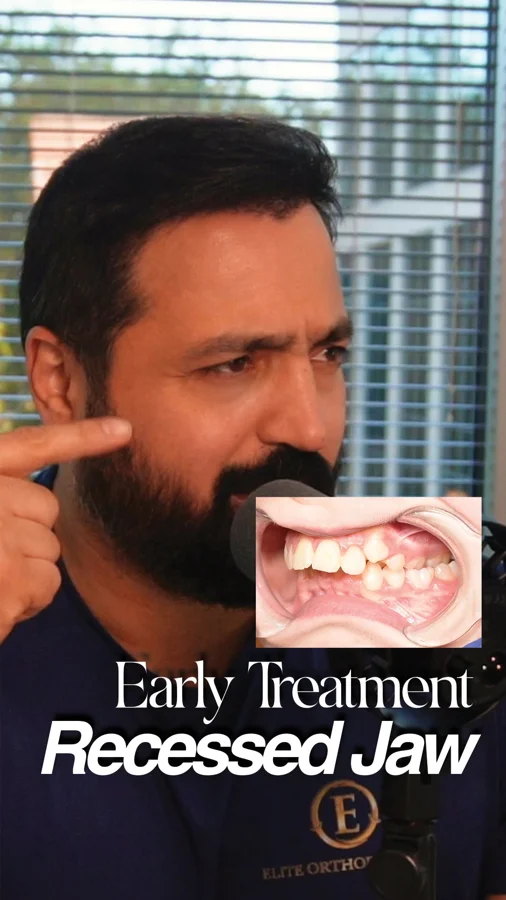
A lower jaw that sits farther back relative to the upper jaw can be part of a skeletal Class II pattern. But the appearance of the profile is only one piece of the assessment. Tooth position and the relationship between the jaws need to be considered together.
Ask what the clinical records show about tooth position and the jaw relationship. A clear explanation makes it easier to understand why one approach is proposed and whether another would address the same goal.
Ask what timing changes
The caption emphasizes childhood and early adolescence because some orthodontic approaches are designed around growth. That does not mean every child with a similar-looking profile needs immediate treatment. The AAO describes early assessment as a way to identify when treatment or observation is appropriate.
Ask how the clinician has assessed development and why the proposed timing matters in this case. “Starting now” should have a reason connected to the findings. It is equally reasonable to ask what would be monitored if the recommendation is to wait, and when the decision should be revisited.
Read the functional-appliance evidence carefully
A randomized trial by Radwan and colleagues compared Twin Block treatment with fixed-appliance care in 40 growing children with mandibular retrusion. The study reported changes in oropharyngeal volume and oxygen-desaturation measurements. These findings are relevant to how clinicians investigate a possible breathing effect.
The children did not have to have diagnosed sleep-disordered breathing to enter the trial. Therefore, the results should not be described as a demonstrated cure for pediatric sleep apnea. Nor do they establish that changing a childhood jaw relationship prevents future disease. Diagnosis, patient selection, and the outcome measured remain essential.
Give each part of a combined plan a purpose
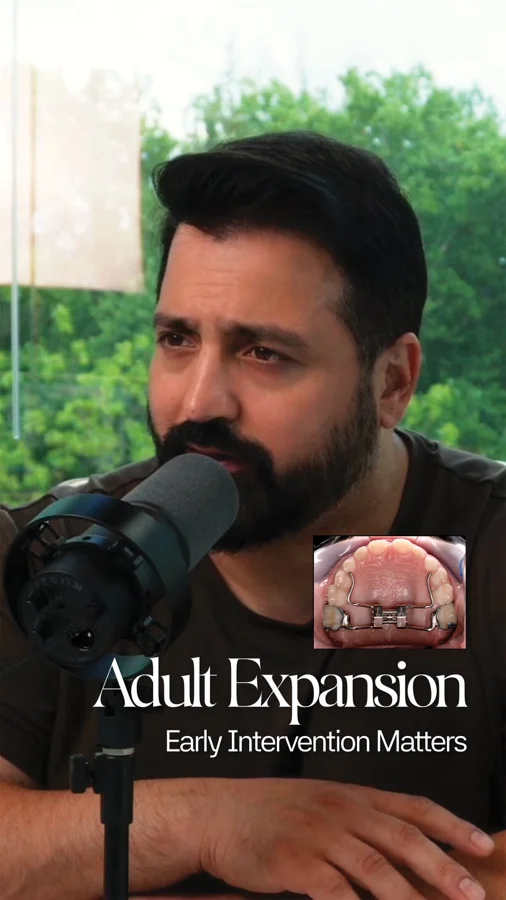
The caption also mentions palatal expansion when indicated. A combined plan should explain why upper-jaw width and the lower-jaw relationship each need attention. One appliance should not be added simply because another is being considered or because an animation shows both.
If sleep or breathing is a concern, bring that history to the airway evaluation and ask how it will be investigated. A useful consultation connects the bite diagnosis, developmental timing, possible treatment choices, and any medical referrals. It also explains how the team will judge success in the areas that matter to your child.
Mandibular retrognathia: a sagittal relationship requiring a complete diagnosis
Mandibular retrognathia describes a posterior relationship of the lower jaw relative to the craniofacial reference being used. It is not interchangeable with a large overjet, a retrusive-looking chin, or a Class II molar relationship. Those features may have different skeletal and dentoalveolar contributions. Clinical interpretation includes the maxillary position, vertical facial pattern, occlusion, growth status, and functional examination rather than relying on one profile view.
This distinction matters when evaluating an airway claim. A posterior mandibular relationship can be relevant to the surrounding soft-tissue environment, but the photograph does not show sleep-state muscle behavior or the site and severity of obstruction. The orthodontic and sleep questions should be documented separately, then connected only where the clinical evidence supports that connection.
What functional-appliance research does—and does not—answer
The cited randomized trial studied children with a defined Class II skeletal pattern and compared treatment groups. That design is more informative than a single before-and-after profile image, but it still requires attention to the enrolled population, comparator, follow-up interval, and measured respiratory outcomes. A result in selected growing children cannot automatically be extended to every child with a small-looking chin or to an adult with OSA.
When functional-appliance treatment is being considered, a clinically useful discussion distinguishes the occlusal goal from any proposed respiratory benefit. It should explain how growth potential, cooperation, dental movements, and subsequent treatment phases affect the plan. A change in jaw posture while an appliance is worn is also not the same question as the stability of the completed correction. Objective sleep assessment remains necessary when the concern is a suspected sleep disorder.
Bring the conversation to your visit.
- What do the records show about tooth position versus jaw position?
- Why is this the appropriate stage to treat or monitor my child's growth?
- How would a breathing concern be assessed separately from bite correction?
Supporting studies & resources
These resources add clinical context to the original post. Each publication should be read with its study population, methods, and outcomes in mind.
- Effect of functional appliances on sleep-disordered breathing in Class II division 1 malocclusion children: Randomized controlled trial Radwan et al. · Orthodontics & Craniofacial Research · 2024 · Randomized trial
- What Are the Benefits of Early Orthodontic Treatment? American Association of Orthodontists · 2026 · Patient education
- Management of the Developing Dentition and Occlusion in Pediatric Dentistry American Academy of Pediatric Dentistry · 2024 · Clinical best practice
- Policy on Obstructive Sleep Apnea (OSA) American Academy of Pediatric Dentistry · 2026 · Professional policy