Read the case for the information it provides
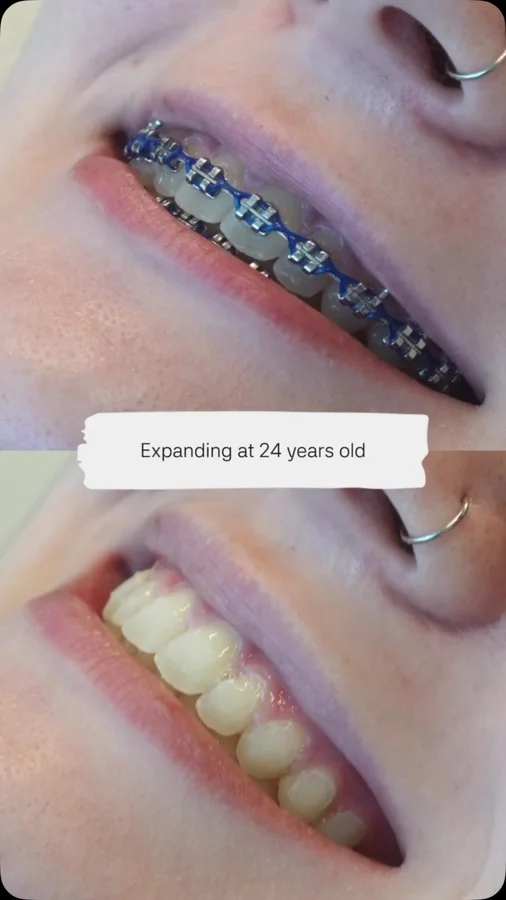
The question in the post is whether age 24 is too late for expansion. Its caption provides a useful example of individualized adult orthodontic planning: expansion and braces were combined for a particular patient. That is the extent of the clinical detail available in the caption.
A completed smile can start a discussion, but it cannot reveal the full diagnostic reasoning. The post does not tell us how expansion was obtained, which alternatives were considered, or what measurements changed. A case is most useful when it helps you formulate questions rather than assume that the same plan will suit you.
Replace a universal age cutoff with an assessment
Adult expansion planning involves more than the number on a birthday. In an imaging study of 78 adults, Angelieri and colleagues found variation in midpalatal suture maturation. Most sutures were fused, but some were not. The study supports considering the individual anatomy rather than relying on age alone.
That finding is not a promise that nonsurgical expansion will work for every adult. Ask what the clinician needs to know about your jaw width, teeth, supporting tissues, and treatment goals before discussing an approach. The recommendation should explain both what appears possible and what remains uncertain.
Keep dental and sleep outcomes separate
Research has examined adult MARPE and surgically assisted expansion approaches in selected patients with sleep apnea. Those studies provide reasons to investigate possible benefits, but they also have limits, including small samples, selected participants, or incomplete outcome data.
The age-24 caption reports an orthodontic result, not measured sleep improvement. If better breathing is one of your goals, tell the team explicitly. Ask whether there is a diagnosed sleep or nasal problem and how any change would be evaluated. A wider-looking smile is not a substitute for that assessment.
Build a plan around your own priorities
Bring the post to a consultation and explain what drew your attention: the age, the narrow palate, or the treatment combination. Ask which similarities and differences are clinically relevant to your case.
Use the airway evaluation to organize any breathing or sleep concerns alongside your orthodontic goals. Before choosing treatment, ask about alternatives, the proposed sequence, follow-up, and what happens if the planned expansion is not achieved. Individual planning should make the decision clearer, rather than simply reproduce a result seen online.
Reading an adult expansion case as a phenotype, not an age rule
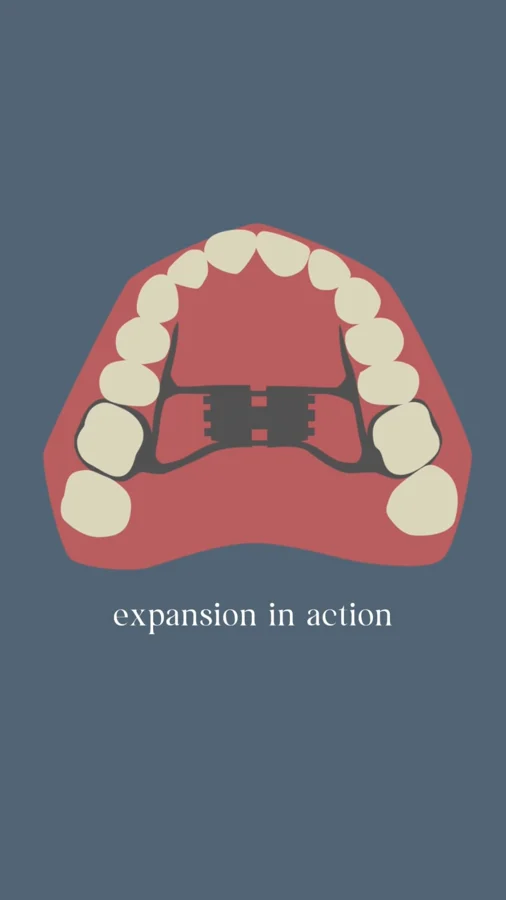
An adult expansion example is clinically informative only when the underlying transverse discrepancy and treatment method are defined. Chronological age alone does not describe midpalatal suture morphology, the amount of skeletal constriction, periodontal support, or the forces delivered by an appliance. The distinction between dentoalveolar widening and skeletal separation is particularly important when interpreting photographs of an adult dental arch.
For the case described in the post, the public material does not provide a complete diagnostic record. It therefore cannot establish the patient’s baseline sleep physiology, suitability for other expansion methods, or long-term stability. A useful educational reading asks which measurements would clarify those issues rather than treating a visible change as proof of a respiratory outcome. Individual morphology and the documented indication remain central to the interpretation.
Which outcomes would support an adult airway claim?
The adult MARPE trial evaluated selected patients with transverse maxillary deficiency and OSA, using both symptom measures and sleep-testing outcomes. Its findings support investigation of a defined clinical phenotype; they do not make any adult dental expansion equivalent to that study intervention. Similarly, surgically assisted approaches involve additional selection criteria and a different risk-benefit discussion.
For a reported individual case, meaningful follow-up would identify the intervention, the timing of the measurements, any concurrent sleep treatment, and the outcome that changed. Nasal comfort, daytime sleepiness, apnea frequency, and arch width belong in separate columns of that assessment. If CPAP, medication, weight, or nasal treatment changed during the same interval, those changes matter to interpretation. An adult should not infer from a social post that an established sleep-apnea treatment can be discontinued without the treating medical team’s reassessment.
Bring the conversation to your visit.
- Which expansion approach is being proposed, and why does it fit my findings?
- What outcome can the plan reasonably address beyond the appearance of my smile?
- How would the plan change if the expected expansion is not achieved?
Supporting studies & resources
These resources add clinical context to the original post. Each publication should be read with its study population, methods, and outcomes in mind.
- Cone beam computed tomography evaluation of midpalatal suture maturation in adults Angelieri et al. · International Journal of Oral and Maxillofacial Surgery · 2017 · Cross-sectional imaging study
- Mini-implant assisted rapid palatal expansion (MARPE) effects on adult obstructive sleep apnea (OSA) and quality of life: a multi-center prospective controlled trial Brunetto et al. · Progress in Orthodontics · 2022 · Prospective nonrandomized controlled trial
- Distraction Osteogenesis Maxillary Expansion (DOME) for adult obstructive sleep apnea patients with narrow maxilla and nasal floor Yoon et al. · Sleep Medicine · 2020 · Retrospective cohort study