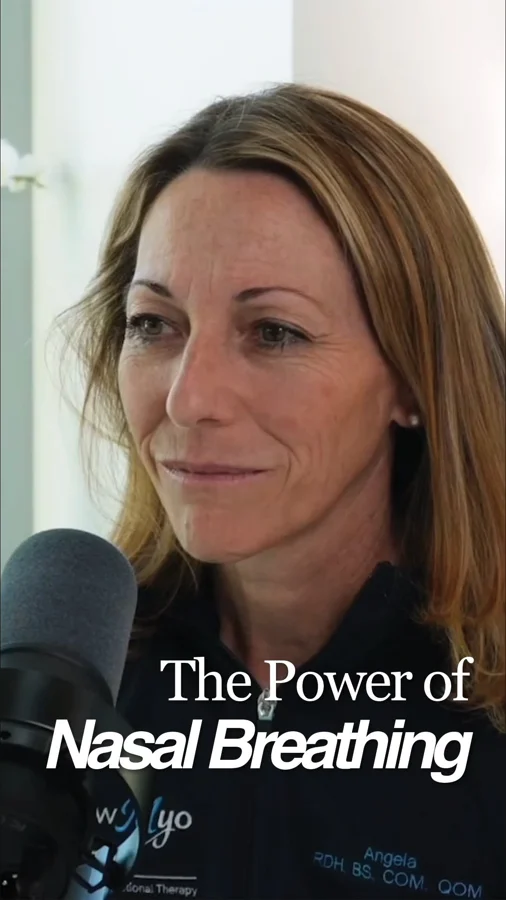
The nose has an active role
The caption emphasizes that nasal breathing is more than a habit. Air passing through the nose is filtered, warmed, and humidified. This is one reason an airway conversation asks not only whether someone can move air, but whether nasal breathing feels comfortable during ordinary daily life.
For families, the useful starting point is descriptive: what does comfortable breathing look and feel like for this person? Someone who reports needing an open mouth to feel at ease is raising a question worth exploring. The answer should come from understanding the reason for that experience, rather than from simply telling the person to close their lips.
Structure and function belong in the same conversation
Dental development, oral posture, and breathing patterns can appear together in clinical assessments. An observational study compared craniofacial measurements in mouth-breathing children with other groups and found some shared patterns. That kind of association can guide questions, but cannot prove that one behavior caused a particular face shape or predict an individual child's future sleep disorder.
This distinction keeps the conversation constructive. A clinician can identify a narrow arch or another finding and explain its significance without attributing every feature to breathing. Families should hear what is known from their examination, what remains a question, and which observations will help clarify the picture.
Investigate difficulty before practicing a change
ASHA describes how nasal obstruction and other medical contributors can affect oral resting posture and function. That supports a sensible sequence: understand whether the nasal passage is comfortable and usable before treating an open-mouth pattern only as a learned habit. Functional support works best when it addresses the person's actual situation.
Ask whether a medical assessment, dental assessment, or both would help answer the concern. If therapy is proposed, ask what functional goal it targets and how progress will be measured. This creates a plan with a clear purpose, rather than a collection of exercises chosen because they seem generally related to breathing.
Describe the pattern, then follow the findings
Useful observations include when nasal breathing feels difficult, whether the pattern changes with illness, and whether there are separate concerns during sleep. You do not need to make every observation at once. A short account of a few typical situations can give the care team a useful starting point.
The post's broader message is to take function seriously. A breathing pattern can lead to an informed discussion about anatomy, development, and appropriate care without committing a patient to treatment in advance. Use the airway evaluation to organize your concerns, then ask the team to explain how the findings connect to the next recommended step.
Establish nasal patency before interpreting an open-mouth posture
An open-mouth resting posture may reflect impaired nasal patency, reduced labial competence, an established orofacial movement pattern, or a combination of factors. A clinician therefore asks whether nasal breathing is comfortable and sustainable before treating the posture as a habit to be corrected. Symptoms that vary with infections, allergens, or time of day may provide useful context for the medical evaluation.
The dental and functional examinations contribute different information. Occlusion and maxillary development describe the structural environment; observation of the lips, tongue, and swallowing describes function. Neither alone identifies every cause of impaired nasal breathing. The role of multidisciplinary assessment is to determine which findings are clinically meaningful and which can be addressed through the appropriate discipline. Simply instructing a patient to keep the mouth closed does not explain why the posture developed or resolve an underlying obstruction.
Interpret associations with facial morphology cautiously
Studies comparing mouth-breathing and nasal-breathing groups may identify differences in craniofacial measurements. These associations do not establish a single direction of causation in an individual child. Growth pattern, obstruction, oral posture, and other influences may interact, and a cross-sectional observation cannot determine which factor came first.
For follow-up, identify the target explicitly: nasal symptoms, resting posture, swallowing function, occlusion, or sleep physiology. A change in one measure should not automatically be counted as improvement in all of them. The expansion literature adds a further question about whether correcting a selected transverse deficiency changes specific anatomical or functional outcomes. It does not justify treating every mouth-breathing child with the same intervention. The useful clinical objective is a coordinated explanation of the patient’s findings, followed by treatment and reassessment matched to those findings.
Bring the conversation to your visit.
- What might be making nasal breathing uncomfortable?
- Are the structural and functional findings related in this case?
- What needs to be assessed before beginning any breathing or oral-function exercises?
Supporting studies & resources
These resources add clinical context to the original post. Each publication should be read with its study population, methods, and outcomes in mind.
- Impact of rapid palatal expansion on the size of adenoids and tonsils in children Yoon et al. · Sleep Medicine · 2022 · Retrospective cohort study
- Mouth breathing children have cephalometric patterns similar to those of adult patients with obstructive sleep apnea syndrome Arquivos de Neuro-Psiquiatria · 2009 · Case-control study
- Orofacial Myofunctional Disorders American Speech-Language-Hearing Association · Undated · Professional guidance
- Policy on Obstructive Sleep Apnea (OSA) American Academy of Pediatric Dentistry · 2026 · Professional policy